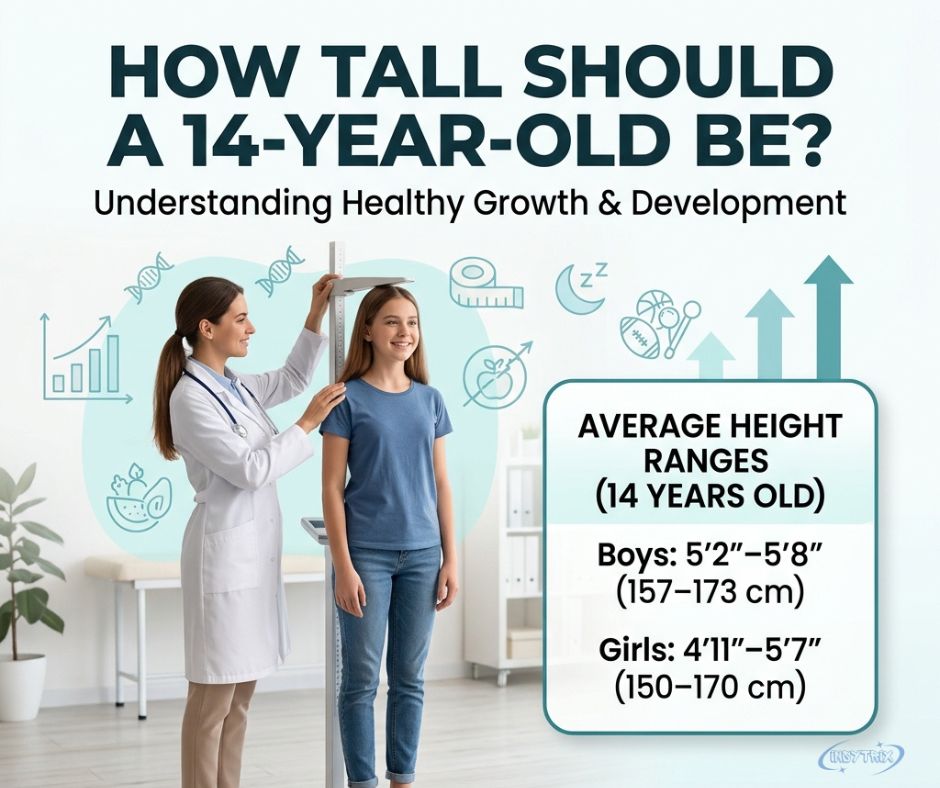
How Tall Should a 14 Year Old Be? A Parent’s Complete Growth Guide
Every parent wonders at some point, how tall should a 14 year old be, especially when classmates seem to shoot up at wildly different rates. The truth is simpler than it looks. Height at this age depends on genetics, timing of puberty, and everyday habits like sleep and nutrition. Checking the average height for 14 year old teens gives a useful starting point, but real answers come from tracking growth over time rather than comparing one number to another.
A height chart by age shows where your teen falls on a normal curve, while understanding the teenage growth spurt helps explain sudden jumps. This guide walks through exactly what counts as typical, and what does not.
Average Height for 14 Year Olds
Most parents want a quick benchmark, and that is fair. The average height for 14 year old boys in the United States sits around 5 feet 5 inches, while girls average closer to 5 feet 3 inches. These numbers come from long-term health surveys, not guesswork, and they shift slightly year to year based on nutrition trends across the country.
Keep in mind that averages hide a wide range. A boy who stands 5 feet 1 inch is not necessarily behind, and a girl at 5 feet 7 inches is not “too tall.” The normal range for teenagers at this age spans several inches in either direction, and most of that variation sorts itself out by adulthood.
| Gender | Average Height (14 yrs) | Typical Range |
| Boys | 5’5″ (165 cm) | 5’0″ – 5’9″ |
| Girls | 5’3″ (160 cm) | 5’0″ – 5’6″ |
Height Growth Charts by Age
A height chart by age gives far more insight than a single average ever could. Doctors in the US rely on charts published by the CDC (Centers for Disease Control), which track height against age using percentile lines. If your teen sits at the 60th percentile, that means they are taller than 60 percent of teens their age and gender.
Reading a height and weight chart for teens is easier than it looks. Find your teen’s age along the bottom, trace up to their height, and see where that point lands among the curved lines. A height percentile calculator online can do this instantly if you would rather skip the manual chart. The WHO (World Health Organization) also publishes similar charts used internationally, and both agree on the same general growth patterns.
Factors That Affect a Teenager’s Height
Height rarely comes down to one cause. Genetic height factors play the biggest role, and scientists estimate that genetics account for roughly 80 percent of how tall someone ends up. This explains why tall parents usually raise tall kids, though exceptions happen constantly.
That said, environment still matters a great deal. Sleep, stress, illness, and diet all influence how well a teenager’s body executes its genetic blueprint. A teen dealing with stunted growth causes such as chronic illness or poor nutrition may fall short of their genetic potential, even with tall parents. Family height pattern tracking, where parents look at grandparents and siblings too, often gives a clearer picture than genetics alone.
Puberty and Growth Spurts at Age 14
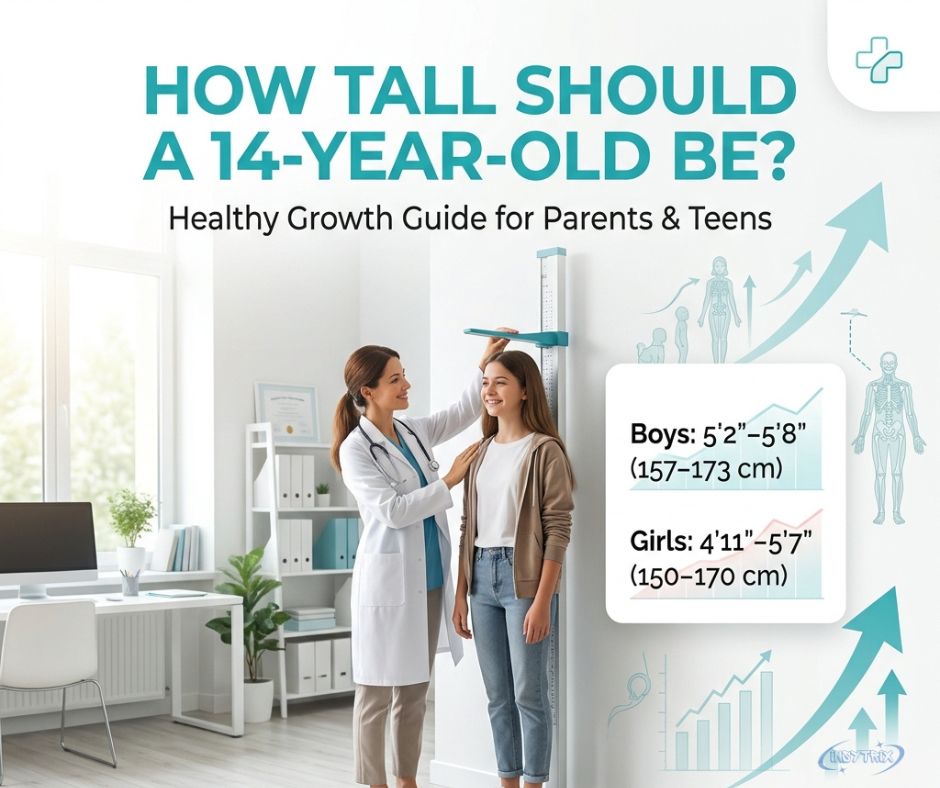
Fourteen sits right in the middle of the action for most teens. A teenage growth spurt can add two to four inches in a single year, and this burst of growth is tightly linked to puberty stages in teenagers. Doctors often reference the Tanner Stages, a five-stage system that tracks physical development from childhood through full maturity.
The signs of puberty in boys and girls differ quite a bit. Boys tend to see growth spurts later, often between ages 12 and 16, while girls usually spurt earlier, between ages 10 and 14. This timing gap explains why a 14 year old girl might already be near her adult height while a 14 year old boy still has significant growing left to do.
“Puberty is not a race. Two teens can reach the same finish line on completely different timelines, and both are perfectly normal.” — Pediatric growth specialist
Is My 14 Year Old Too Short or Too Tall?
This question keeps parents up at night, and honestly, it rarely needs to. Most teens who look short or tall compared to classmates are simply on a different part of the same normal curve. Short stature causes only become a medical concern when height falls well below the 3rd percentile on standardized charts, not just below the classroom average.
A more useful approach looks at growth velocity over time rather than a single snapshot. If your teen has followed the same percentile line for years and suddenly drops off it, that shift matters more than the raw number. Sudden changes in growth pattern are the real signal worth watching, not where a teen ranks against friends.
How to Predict Adult Height
Parents love a formula, and the mid-parental height formula is the most commonly used one. Add the mother’s and father’s height together, add 5 inches for a boy or subtract 5 inches for a girl, then divide by two. This gives a rough adult height prediction, usually accurate within a few inches.
Doctors sometimes go further using a bone age test, which uses an X-ray of the hand and wrist to estimate skeletal maturity. This method offers a sharper picture of height growth after puberty because bone age reveals how much growing time remains, regardless of a teen’s current height. Height inheritance plays a role here too, since bone maturation patterns often run in families.
How to Support Healthy Growth in Teens
Genetics set the ceiling, but daily habits determine how close a teen gets to it. Foods that increase height are really just foods that support overall development, think calcium and vitamin D for growth, lean meats, eggs, and dairy. Protein intake for teenagers deserves special attention since protein builds the tissue that bones and muscles need to grow.
Sleep and height growth are more connected than most parents realize. Growth hormone releases mainly during deep sleep, so a teen skimping on rest may be skimping on growth too. Exercise for height growth also matters, particularly weight-bearing activities like basketball, swimming, or running, which stimulate bone density. Following simple healthy growth tips for teenagers consistently often does more than any supplement ever could.
| Habit | Why It Matters |
| 8-10 hours sleep | Triggers growth hormone release |
| Protein-rich meals | Supports tissue and bone growth |
| Calcium + Vitamin D | Strengthens developing bones |
| Weight-bearing exercise | Stimulates bone density |
When to See a Doctor About Height Concerns
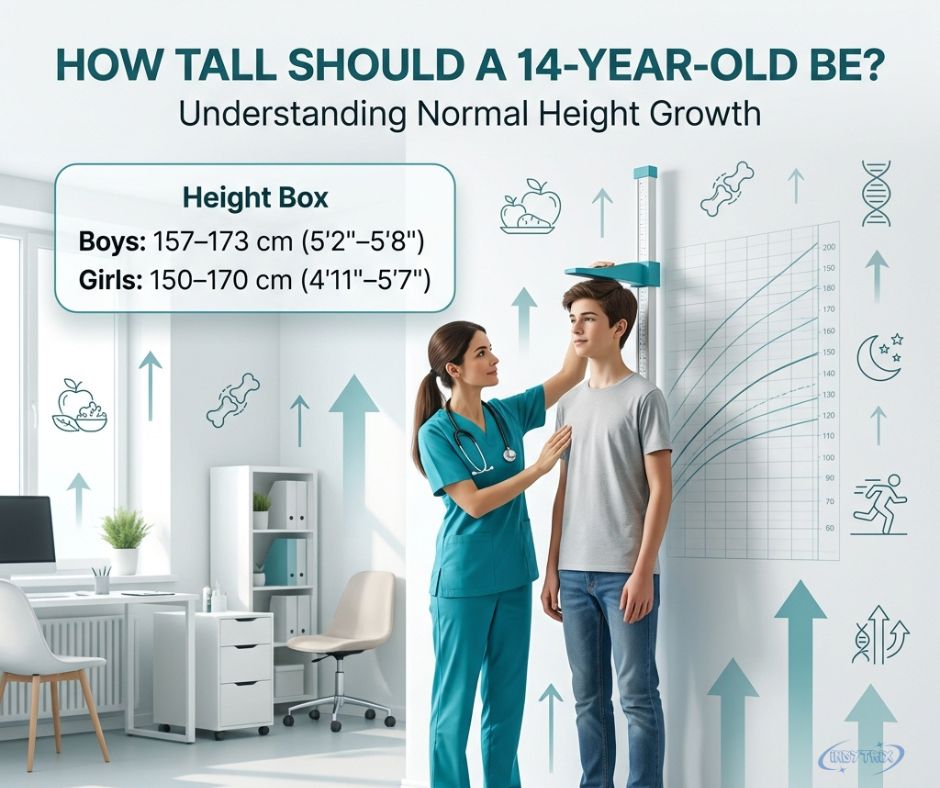
Most height differences need nothing more than patience. Still, certain signs justify a conversation with a professional. Knowing when to see a doctor about height starts with watching for delayed puberty, meaning no signs of development by age 14 in boys or 13 in girls, or early puberty, where development starts unusually soon.
A pediatric endocrinologist specializes in exactly these situations. They can check for growth hormone deficiency, a condition where the body does not produce enough of the Growth Hormone (GH) needed for normal development. If deficiency is confirmed, growth hormone therapy can help, though it works best when started early rather than after growth plates have closed.
Common Myths About Teen Height
Height myths spread fast, mostly because they sound believable. One popular claim says drinking extra milk guarantees extra inches. Milk helps, but no food alone overrides genetics. Another myth insists stretching exercises or hanging from bars can lengthen bones. Neither practice changes bone length, though both are harmless habits otherwise.
A trickier myth claims puberty timing has no connection to final height. That is simply wrong. Hormonal changes in teens during early or late puberty directly shape the growth window. Teens who start puberty early often finish growing sooner, while late starters sometimes catch up and even surpass early-developing peers by adulthood.
FAQs
Can a 14 year old still grow taller?
Yes, absolutely. Most 14 year olds, especially boys, have significant growing left, sometimes continuing into their late teens or early twenties.
What is a good height for a 14 year old boy?
Anywhere between 5 feet and 5 feet 9 inches falls within the normal range, with 5’5″ sitting near the average.
What is a good height for a 14 year old girl?
Between 5 feet and 5 feet 6 inches is typical, with most girls averaging around 5’3″ at this age.
Is 5’4″ short for a 14 year old?
Not at all. For both boys and girls, 5’4″ sits comfortably within the normal range for teenagers.
How much taller will I grow after 14?
This varies widely, but many teens gain another 2 to 6 inches after 14, depending on their puberty stage and genetics.

Welcome to Insytrix I’ m Habib Saleem, an AI-Powered SEO, and content writer with 3 years of experience.I help websites rank higher, grow traffic, and look amazing. My goal is to make SEO and web design simple and effective for everyone. Let’s achieve more together!














Post Comment